In August 2026, San Francisco-based Bedrock Robotics announced that excavators running its system had achieved fully autonomous operation on real customer jobsites — no driver, no remote control; the machines dig and relocate on their own. AI's front
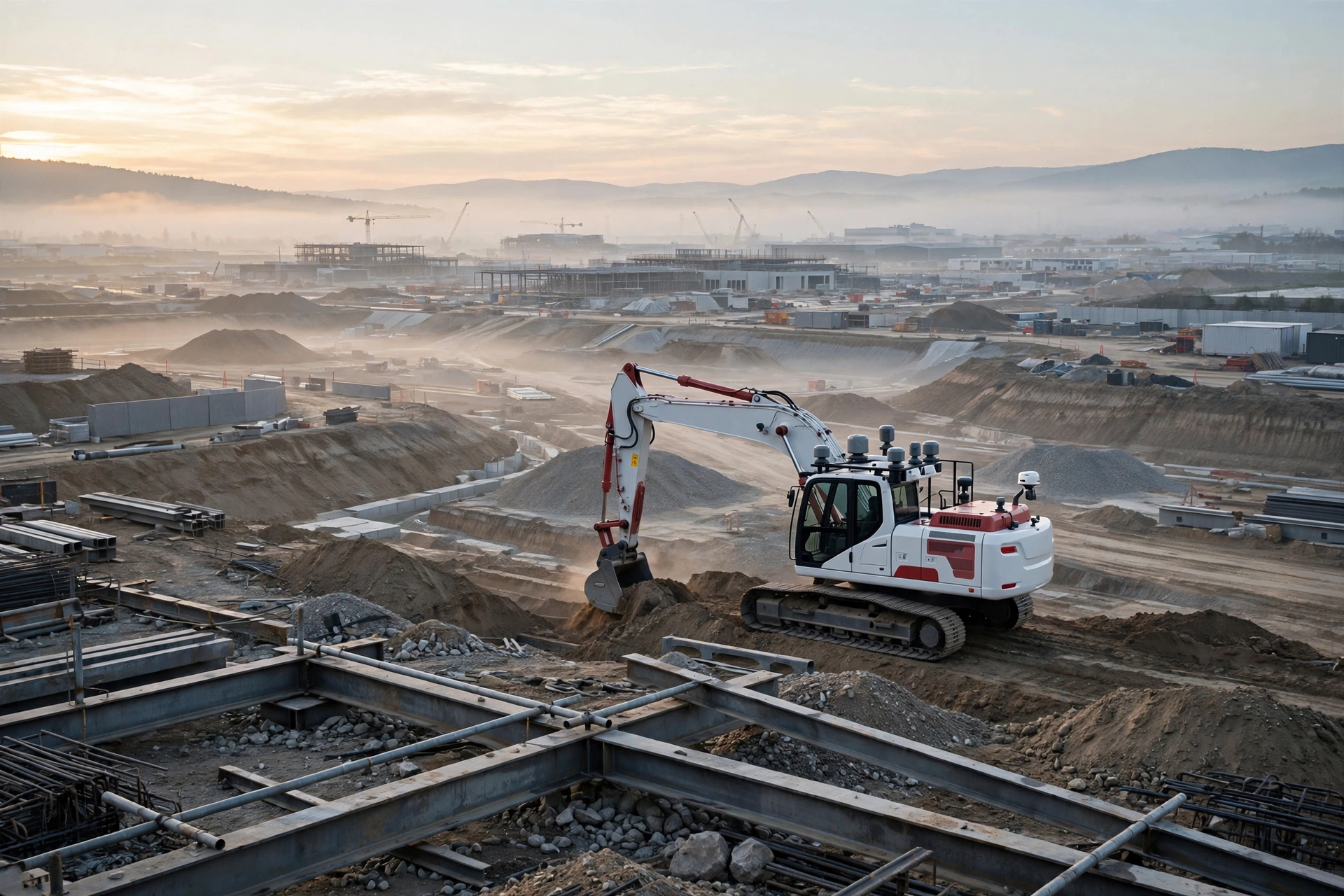
In August 2026, San Francisco-based Bedrock Robotics announced that excavators running its system had achieved fully autonomous operation on real customer jobsites — no driver, no remote control; the machines dig and relocate on their own. AI's frontier is advancing from the digital world into the physical front lines of production. For construction, this isn't a concept demo — it's the beginning of landed answers to the capacity problem.
Bedrock's announcement came fast: the company emerged from stealth only last year, and a year later its fully autonomous excavators were working on critical U.S. infrastructure projects. A Nevada water treatment plant with Sundt Construction, a multi-million-cubic-yard earthworks site in Texas with Champion Site Prep, a 1.2-million-cubic-yard civil job with Zachry Construction — all real projects under construction, not test fields. Bedrock's next goal is more aggressive: fleets of mixed machine types that orchestrate themselves — planning, coordinating, and executing entire sequences of work "at a pace and scale the industry has never seen."
Meanwhile, this July, 10 autonomous machines from Built Robotics drove up to 1,000 steel piles a day into the ground at a solar farm jobsite in Louisiana. Each 72-ton machine — a standard Caterpillar excavator retrofitted with software and sensors — works more than 12 hours a day. The solar farm will power Meta's Hyperion data center in Richland Parish — a 3,650-acre campus with initial power demand of 2 gigawatts. Built Robotics just signed a $75 million contract with renewable contractor Blattner Energy, the 8th project in the partnership. CEO Noah Ready-Campbell put it bluntly: manually handling 200-pound steel piles is backbreaking work nobody wants to go back to — and now 10 robots do the work of three to four times the human crew.
Behind the robots is a labor math the construction industry simply can't sustain. Industry statistics show U.S. construction needs a net 349,000 new workers in 2026 — but there's nobody to hire: about 20% of construction workers are over 55, and roughly 40% of the workforce will retire within five years. Large projects run 20% over schedule and 80% over budget on average, while construction workers make up just 7.5% of the labor force yet account for 20% of workplace fatalities. When "no one to do the work, work that can't get done, and work that's dangerous" all hold true at once, automation stops being optional and becomes mandatory.
Notably, 2026's construction robots have split into distinct lanes. McLaren Construction in the UK partnered with California's FieldAI to bring Boston Dynamics' Spot robot dog onto jobsites: capturing 360-degree imagery, generating point clouds, verifying progress, analyzing model-vs-field deviations, and running safety-compliance patrols and quality acceptance. FieldAI's "foundation model" lets robots navigate autonomously in unfamiliar, unstructured environments without pre-mapping or fixed routes — exactly the hardest scenario on a jobsite.
Another lane is "design–manufacture–assemble" integration. European company All3 closed a $25 million seed round this May (led by RTP Global), using its autonomous assembly robot All3 Mantis alongside AI design software and a robotic prefab factory to rebuild construction as an end-to-end process — claiming 30% cost reduction, schedules cut in half, and 25% lower embodied carbon, with its AI design software already processing over 100,000 square meters of residential projects. At the finishing end, Legend Robot brought its CE-certified latex-paint and putty-spraying robots to the BATIMAT 2026 building expo in Paris in late September, hitting peak spraying speeds of 237 square meters per hour on a hotel renovation project in Athens with 15% less material waste.
Read this trend, then look at our product line, and one conclusion follows directly: robot construction has no tolerance for "make it work on site." Machines work from the model — demanding higher installation precision and standardized interfaces — and that is precisely the opening for prefabricated, modular products.
Our busway, cable tray, low-voltage switchgear, and distribution panels already follow the "factory-prefab, fast on-site assembly" route: moving the field work that once depended on veteran craftsmen into the controlled factory environment. When the excavator on site is AI and the inspector is a robot dog, the less secondary field processing the MEP installation needs, the smoother the project runs. The next step worth taking: making our products "machine-readable" — complete BIM component libraries, millimeter-accurate installation tolerance data, standardized connection interfaces — so AI scheduling and automated installation can call on our product data directly.
The tipping point for construction automation has arrived. For MEP equipment makers, the question is no longer "whether to follow" but "whether our products can be installed smoothly by machines." Going deeper on prefabrication and further on digitalization is our ticket into the robot era.